Retargeting That Brings the Right Visitors Back — and Pays Back Fast
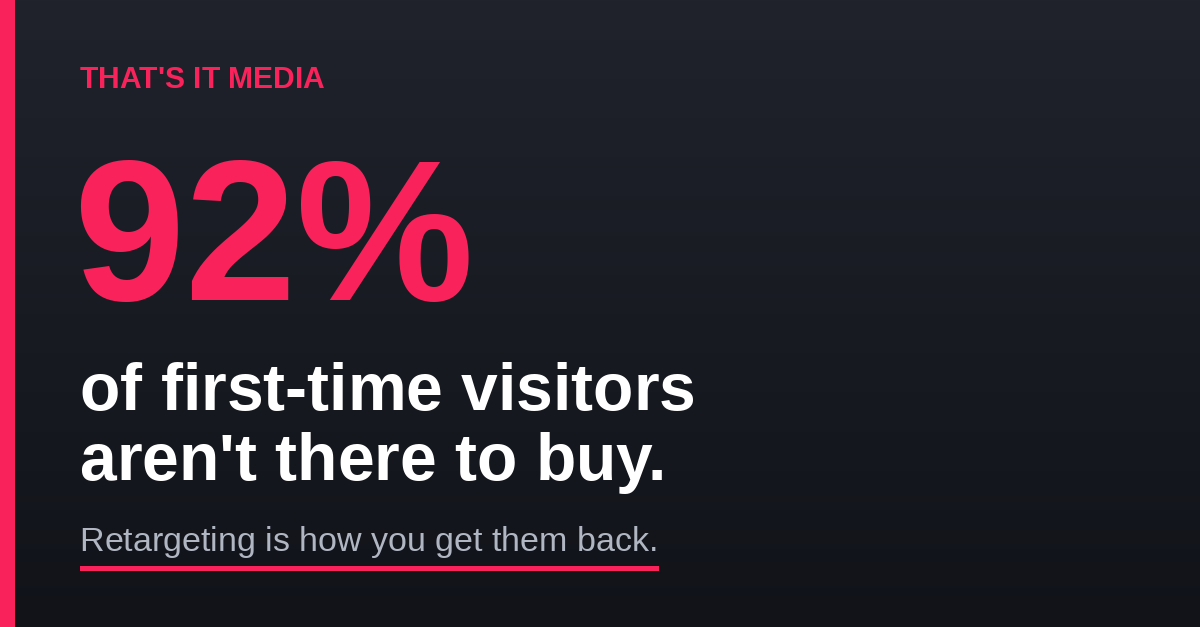
Around 92% of first-time website visitors aren't there to buy. That's not a failure of your site — it's how people shop. They compare, they wander, they leave.
Retargeting is how you stop paying for that traffic once and earning from it never. Done properly, it's consistently one of the highest-ROAS line items in a paid media account — because you're only spending money on people who already told you they're interested.
Done badly, it's the ad that follows someone around the internet for a month after they bought the thing. We don't do that version.
What Is Retargeting?
Retargeting (also called remarketing — same thing, different platform vocabulary) shows ads to people who have already interacted with your brand: visited your site, viewed a product, abandoned a cart, watched a video, or opened an email.
Instead of bidding for the attention of strangers, you're re-engaging people who are partway through a decision. That's why retargeted ads reliably out-click and out-convert standard display ads — the audience has pre-qualified itself.
The mechanics are simple: a tag on your site (or a server-side event stream) builds audiences based on behaviour, and those audiences see tailored ads across Google's display network, YouTube, Meta, LinkedIn and beyond.
The strategy is where the money is made or wasted.
Why Retargeting Works — the Plain-English Version
Think of your paid traffic as a leaky bucket. You pay for the click, the visitor looks around, and most of them leave. Without retargeting, that spend is gone.
With retargeting:
You segment by intent, not just by visit
Someone who bounced off your homepage in 4 seconds is not the same audience as someone who spent 3 minutes on your pricing page. They shouldn't see the same ad, the same offer, or the same landing page.
You match the message to the moment
Early-stage visitors get useful content that builds trust. Cart abandoners get the nudge — the reassurance, the reminder, sometimes the incentive. Past customers get the cross-sell, not the intro pitch.
You control frequency
The line between "helpful reminder" and "brand damage" is a frequency cap. We set them deliberately, per audience, per platform.
You exclude ruthlessly
Converters come out of acquisition audiences immediately. Nothing burns budget and goodwill faster than advertising a product to someone who bought it yesterday.
How We Approach Retargeting
Numbers never lie — so every build starts with the data, not the ads.
Audit the signal
Before touching audiences, we check what your tracking actually captures. Broken or thin event data means retargeting garbage in, garbage out. This usually means reviewing your tag setup, conversion events, and consent configuration.
Segment by behaviour and value
We split your visitors into audiences worth different amounts of money — product viewers, pricing-page readers, cart abandoners, lapsed customers, high-value lookalike seeds — and prioritise budget toward the segments with the shortest path to revenue.
Build creative per segment
Each audience gets messaging matched to where they are: educate the early-stage, reassure the hesitant, incentivise the almost-there. One generic "come back!" banner for everyone is where most retargeting programmes go to die.
Land them somewhere new
Retargeting ads should never dump people back on your homepage — they've seen it. Every segment gets a destination that moves them forward: a comparison page, a case study, a checkout with the cart intact.
Measure incrementality, not just ROAS
Retargeting's dirty secret is that it loves to claim credit for conversions that would have happened anyway. We report on what the channel actually added — with holdout thinking and honest attribution — so the numbers you see are numbers you can trust.
Retargeting in 2026: What's Changed
The playbook from five years ago doesn't fully work anymore, and any agency still running it is quietly losing your money:
Third-party cookies are unreliable
Browser restrictions and consent requirements have shrunk the classic pixel-only audience. First-party data — your customer lists, logged-in behaviour, server-side events — is now the backbone of durable retargeting.
Server-side tracking is table stakes
Conversions APIs (Meta CAPI, Google's enhanced conversions and server-side tagging) recover signal that browser-only pixels miss. If your retargeting audiences are still built on client-side tags alone, they're smaller and staler than they should be.
Consent isn't optional
Consent Mode v2 and regional privacy rules shape what you can collect and model. Compliant setups aren't just lower-risk — properly configured, they keep your audiences and measurement usable where sloppy setups go dark.
Platform AI needs feeding
Meta Advantage+ and Google's audience expansion work off the quality of your seed data and conversion signals. Clean events in, better delivery out.
This is exactly the kind of shift where being on the front side of the move matters. The mechanics got harder; the advantage for teams who do it properly got bigger.
Multi-Channel Performance Retargeting: From TV Screen to Mobile Conversion
Most people still think of retargeting as "visited a website, saw a banner." That version is a decade old. Modern performance retargeting connects channels — so the person who saw your ad on the biggest screen in their house can be reached again on the screen in their pocket, and every step in between is measured.
Here's how a full multi-channel flow works in practice:
The first touch happens on CTV
A viewer sees a high-impact campaign on connected TV — premium, big-screen attention that display ads can't match. On its own, though, a TV impression is just awareness. The value comes from what happens next.
The audience is matched — privacy-safe
Programmatic audience matching links TV exposure to mobile devices in the same household, using privacy-compliant identifiers. No personal data changes hands; the match happens at the audience level, not the individual profile level. This is the step that turns a broadcast medium into a performance channel.
Retargeting follows on mobile
The same audience that saw the TV spot now sees a consistent, relevant ad on mobile — including inside the everyday apps where people actually spend their screen time. In-app inventory is one of the most underused placements in retargeting: high viewability, real humans, and creative that appears while someone is genuinely engaged rather than skim-scrolling.
The click becomes a sign-up
Because the user has now seen the brand twice across two screens, the mobile tap converts at a rate a cold impression never would. The landing experience mirrors the ad — same offer, same creative language — so there's no moment of doubt between tap and form.
The sign-up becomes a customer
The final step is the one that matters commercially: activation. First purchase, first order, first transaction — the event your P&L actually cares about.
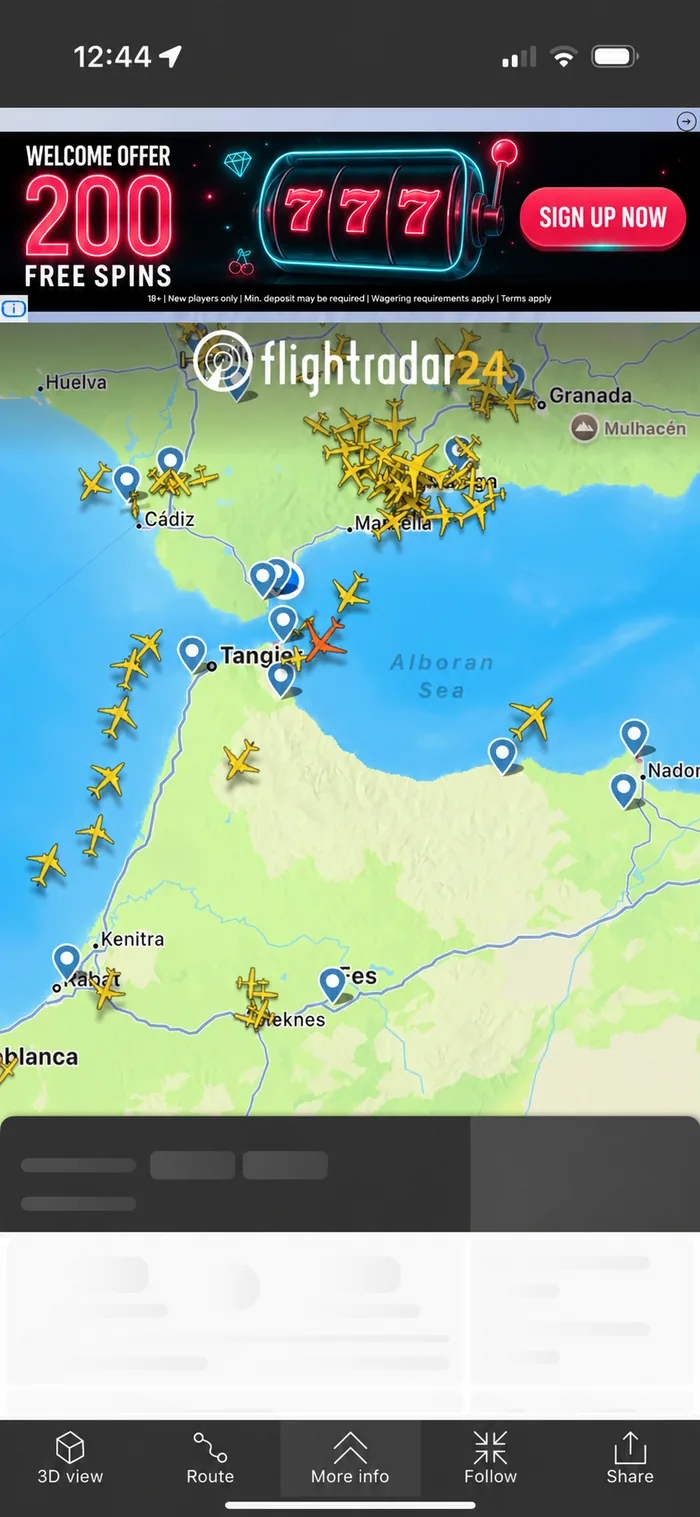
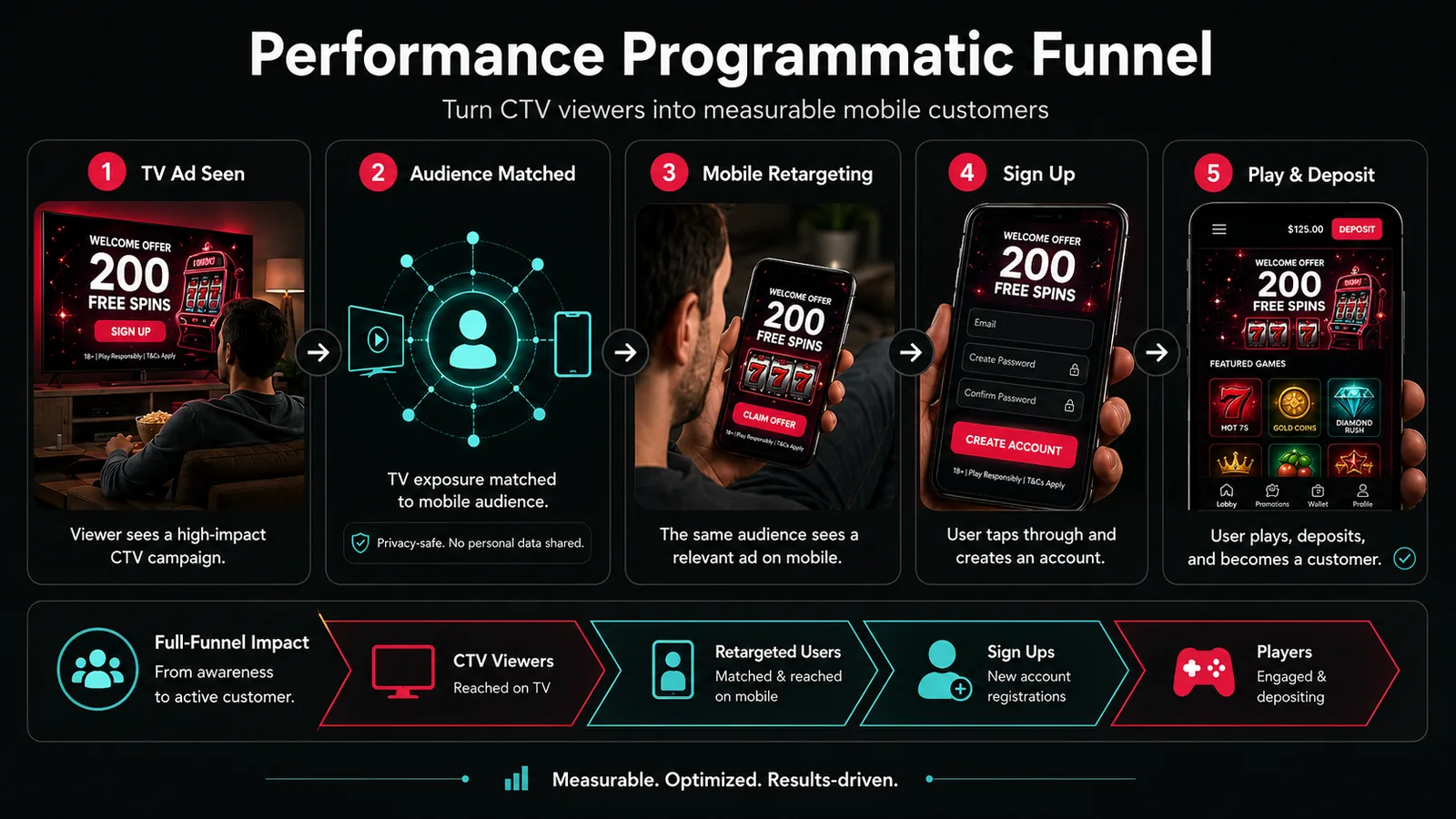
And here's the part we care most about: every stage is measurable. CTV viewers reached, audiences matched, users retargeted on mobile, sign-ups created, customers activated. When each step reports a number, budget decisions stop being opinions. You can see exactly where the funnel leaks and fix that stage — instead of guessing whether "TV worked."
That's the difference between running ads on several channels and running one connected, measured funnel across them. Full-funnel impact, from first impression to active customer — with numbers at every step. Numbers never lie; multi-channel retargeting just gives them more places to speak.
Which Platforms We Retarget On
Google Ads
Display, YouTube, Demand Gen and RLSA (retargeting layered onto search).
Meta
Facebook and Instagram, pixel plus Conversions API.
Website and engagement retargeting for B2B, where the audience is small but the deal sizes justify it.
Programmatic & CTV
Connected TV, in-app and open-web inventory via programmatic buying, with audience matching across screens (see the multi-channel flow above).
Emerging channels
As new inventory opens up (see our take on ChatGPT Ads), retargeting-style audience tools tend to follow. We test early so you don't have to guess.
What Working With Us Looks Like
You get a small, senior team that treats your account like an embedded growth function, not a ticket queue:
Full builds or rebuilds
Audiences, exclusions, creative briefs, landing page recommendations.
Continuous optimisation
Frequency, budget allocation and creative rotation reviewed against the numbers weekly, adjusted fast.
Reporting in plain English
What we spent, what it returned, what changed and why. ROI without the decoder ring.
FAQ
What's the difference between retargeting and remarketing?
In practice, nothing — they're the same tactic with different platform vocabulary. "Remarketing" is Google's historical term; "retargeting" is the industry-wide word. Both mean showing ads to people who've already interacted with your brand.
Does retargeting still work without third-party cookies?
Yes, but the approach has changed. Modern retargeting leans on first-party data, server-side tracking (Conversions APIs), consented signals and platform-modelled audiences rather than third-party cookies alone. Setups that haven't adapted see shrinking audiences and weakening results.
What is CTV retargeting?
CTV (connected TV) retargeting links television ad exposure to follow-up ads on other devices. Households that saw a campaign on connected TV are matched — using privacy-safe, audience-level identifiers — to mobile devices, where the same audience can be re-engaged with consistent creative and measured through to conversion.
What are in-app retargeting ads?
In-app retargeting ads appear inside mobile apps rather than on websites — banner, native or interstitial placements shown to audiences who've previously engaged with a brand or been matched from another channel. In-app inventory typically offers strong viewability because ads render inside active app sessions.
How much does retargeting cost?
Retargeting audiences are smaller than prospecting audiences, so media spend is typically a modest slice of a paid media budget — but it's usually the most efficient slice. Costs depend on audience size, platform and market; the more useful question is incremental return, which is what we report on.
How is retargeting different from normal PPC ads?
Standard PPC targets people by what they're searching or who they are. Retargeting targets people by what they've already done — visited your site, viewed a product, abandoned a cart. The audience is warmer, so click-through and conversion rates are reliably higher than cold display advertising.
Where should retargeting ads send people?
Not your homepage — they've seen it. Each audience segment should land on a page matched to their stage: comparison content for researchers, social proof for the hesitant, a restored cart for abandoners. Ad-to-page continuity is one of the biggest levers in retargeting performance.
How do I know retargeting is actually adding sales?
Watch for over-attribution — retargeting often claims conversions that would have happened anyway. Incrementality checks (holdout audiences, honest attribution windows, view-through scrutiny) separate what the channel created from what it merely witnessed. If your report only shows ROAS, ask harder questions.
Ready to Stop Renting Traffic and Start Keeping It?
If you're driving traffic and not running structured retargeting — or you're running it and suspect it's claiming credit rather than creating value — we'll take a look at the data and tell you straight.